
AN AUTHORITATIVE RESOURCE FOR EVERYTHING ABOUT CANCER
Research
The volume and pace of cancer research, from preclinical studies to clinical trials and FDA approvals, can make it challenging to stay informed. This section highlights the latest developments and translates complex scientific concepts into clear, accessible insights for both healthcare professionals and the broader public.

Monitoring for Interstitial Lung Disease With Trastuzumab Deruxtecan: A Practice-Changing Case
By Erica Doubleday, NP
Antibody-drug conjugates (ADCs) combine the precision of targeted therapy with the cell-killing power of chemotherapy, and few have been more transformative in breast cancer than fam-trastuzumab deruxtecan (T-DXd)
Precision Over Protocol: What's New in HR-Positive, HER2-Negative Breast Cancer
By Sasha Stanton, MD, PhD
Hormone receptor-positive, HER2-negative (HR+/HER2-) breast cancer is the most common subtype of breast cancer and its treatment landscape has never been more complex or more promising.
Precision Over Protocol: What's New in HR-Positive, HER2-Negative Breast Cancer
By Sasha Stanton, MD, PhD
Hormone receptor-positive, HER2-negative (HR+/HER2-) breast cancer is the most common subtype of breast cancer and its treatment landscape has never been more complex or more promising.
Precision Over Protocol: What's New in HR-Positive, HER2-Negative Breast Cancer
By Sasha Stanton, MD, PhD
Hormone receptor-positive, HER2-negative (HR+/HER2-) breast cancer is the most common subtype of breast cancer and its treatment landscape has never been more complex or more promising.
CAR-T Cell Therapy for Relapsed Aggressive Lymphoma: Who to Refer, When, and What's Coming Next
By Paul Shaughnessy, MD
Before CAR-T cell therapy existed, patients with chemotherapy-refractory diffuse large B-cell lymphoma had a median overall survival of 6.3 months, a complete response rate of 7%, and only 20% alive at two years.

Small Cell Lung Cancer in 2026: Tarlatamab Changes the Arc, and a New Wave of ADCs Is Coming
By Rafael Santana-Davila, MD
Tarlatamab has changed the arc of small cell lung cancer — the first treatment in years to improve survival in the second-line setting. Dr. Rafael Santana-Davila maps the 2026 landscape and the ADC wave that's coming.

New Drugs, New Standards: What's Changing in Gastroesophageal Cancer Treatment
By Allan Pereira, MD, PhD
Gastroesophageal cancers (encompassing adenocarcinomas and squamous cell carcinomas of the esophagus and stomach, including gastroesophageal junction tumors) have seen more treatment advances in the past two years than in the preceding decade.

Upper GI Cancers at ASCO 2026: A New HER2-Positive Standard, a Negative Dual-IO Trial, Signals From Asia
By Dr. Ronan Hsieh
Upper GI cancers remain among the most lethal malignancies worldwide, and the treatment landscape has been evolving rapidly since the approvals of trastuzumab in HER2-positive disease and checkpoint inhibitors across the HER2-negative population.
HCC and Pancreatic Cancer at ASCO 2026: TACE Combinations in Liver Cancer, Daraxonrasib's New Standard
By Rachael A. Safyan, MD
ASCO 2026 brought two late-breaking presentations that are reshaping the treatment of hepatocellular carcinoma and pancreatic cancer.
HCC and Pancreatic Cancer at ASCO 2026: TACE Combinations in Liver Cancer, Daraxonrasib's New Standard
By Rachael A. Safyan, MD
ASCO 2026 brought two late-breaking presentations that are reshaping the treatment of hepatocellular carcinoma and pancreatic cancer.
HCC and Pancreatic Cancer at ASCO 2026: TACE Combinations in Liver Cancer, Daraxonrasib's New Standard
By Rachael A. Safyan, MD
ASCO 2026 brought two late-breaking presentations that are reshaping the treatment of hepatocellular carcinoma and pancreatic cancer.
Colorectal Cancer at ASCO 2026: Stopping Immunotherapy, BRAF-Targeted Therapy, and Exercise's Role
By Stacey A. Cohen, MD
Before discussing any of the specific advances from ASCO 2026, the single most important principle in colorectal cancer is straightforward: test all patients for microsatellite instability (MSI).

Prostate Cancer at ASCO 2026: Perioperative Intensification, Earlier PARP Inhibitors, and De-escalation
By Alexandra Sokolova, MD
ASCO 2026 brought multiple practice-influencing trials in prostate cancer spanning localized high-risk disease, metastatic hormone-sensitive disease, and de-escalation for exceptional responders.
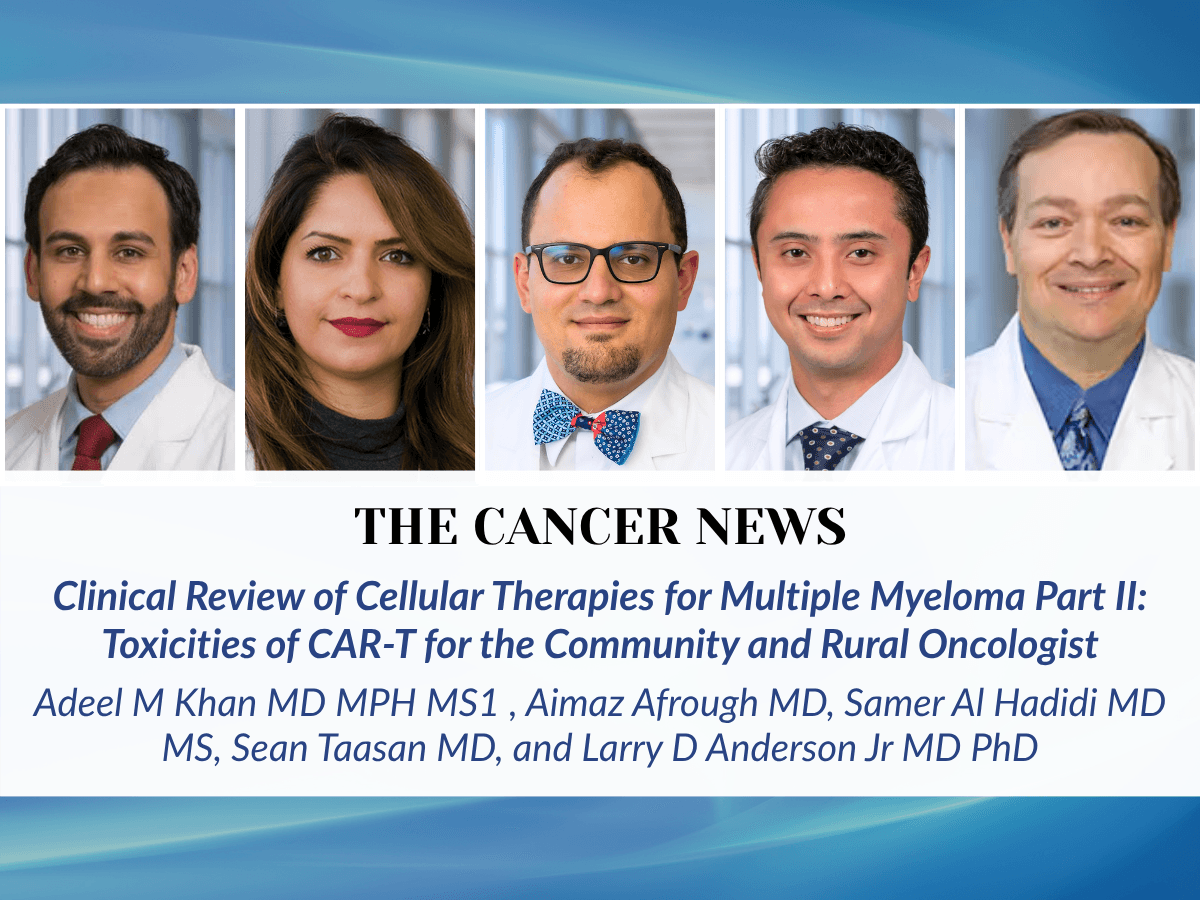
Cellular Therapies for Multiple Myeloma Part II: CAR-T Toxicities for the Community Oncologist
By Aimaz Afrough, MD; Samer Al Hadidi, MD, MS; Sean Taasan, MD; Larry D Anderson Jr, MD, PhD
While ide-cel and cilta-cel are generally considered safe and have remarkable therapeutic impact for relapsed/refractory myeloma, both agents carry a broad and clinically significant toxicity burden that practitioners must recognize and actively surveil.